
This is The Grutt Brothers
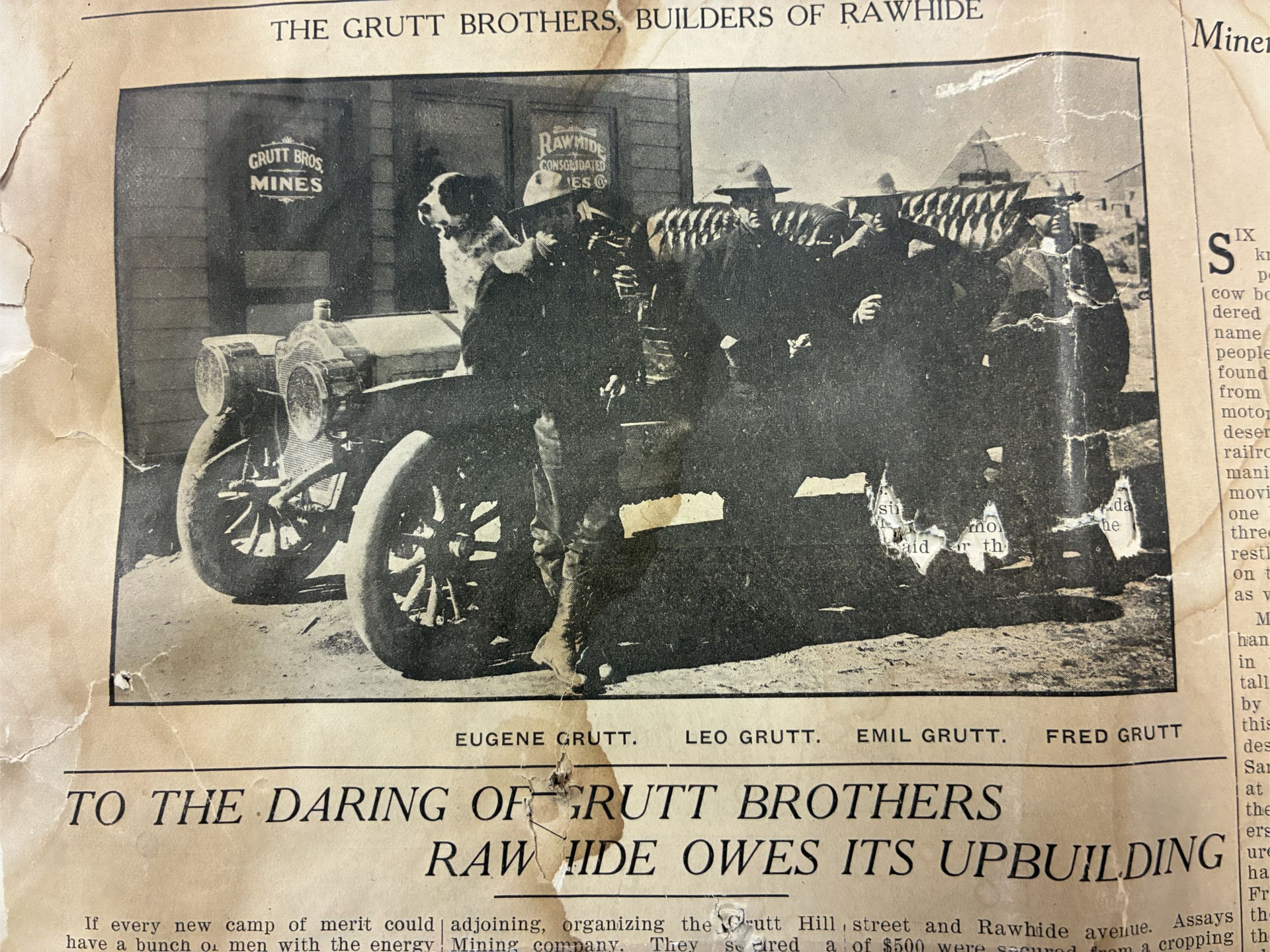
The Grutt brothers—Eugene, Fred, Emil, and Leo—were instrumental figures in the history of Rawhide, Nevada, a legendary boomtown that exploded onto the mining scene in the early 1900s. While Rawhide attracted its fair share of scammers and fast-talking stock promoters, the Grutt brothers were widely regarded as legitimate, hardworking businessmen who helped put the town on the map.
The Grutt brothers arrived in Rawhide in August 1907, just as the area's massive gold and silver rush was gaining momentum. They quickly acquired extensive property in the district, eventually holding 19 patented claims.
· The Initial Strike: The brothers made a major early strike on an area that was promptly named Grutt Hill.
· The "Gruett" Misprint: Early promotional photographs and postcards of their initial gold discovery on Grutt Hill—titled "The Golden Arena"—are highly collectible today. The earliest prints are famous among historians because the photographer, Larson, misspelled their last name as "Gruett," as they were still completely unknown to the public.
· Mining Operations: Under the direction of Eugene Grutt, they formed the Grutt Hill-Truitt Mining Company and the Grutt Hill Coalition Mines Co.. Unlike the deep-vein operations found elsewhere in Nevada, the ore at Grutt Hill was highly concentrated in shallow, epithermal deposits.
The brothers did not just dig for gold; they actively built the town's infrastructure. Together, they helped organize and establish Rawhide’s telegraph company, bringing modern communications to the remote desert camp. They also became stockholders in the Rawhide Western Railway Company, attempting to secure a rail line to handle the massive influx of people and equipment.
Through buying and selling shares of legitimate stock and managing highly productive leases, the Grutts became prominent civic leaders.
As Rawhide grew, so did the need for formal governance in the region. When the territory boomed, the surrounding county lines were redrawn. In 1911, Mineral County was officially carved out of Esmeralda County.
Because of his sterling reputation and leadership during the gold rush, Eugene Grutt was elected as the very first Sheriff of Mineral County. He moved to the new county seat of Hawthorne and served two consecutive terms from 1911 to 1919, successfully transitioning from a pioneer miner to a prominent lawman.
Rawhide's peak was dazzling but incredibly brief. By 1908, the town boasted over 7,000 residents, banks, hotels, and dozens of saloons (including the famous "Northern" saloon run by prize-fight promoter Tex Rickard). However, a catastrophic fire in late 1908 and a flash flood in 1909 crippled the city, and the shallow ore pockets quickly dried up.
By 1910, the population dropped to fewer than 500 people. In the late 20th century, modern open-pit and heap-leach operations by major mining companies completely excavated the historic site—including Grutt Hill itself—effectively erasing the physical layout of the old ghost town. Today, the legacy of the Grutt brothers lives on through historical records, mining certificates, and the preserved stone jailhouse, which was relocated from Rawhide to nearby Hawthorne, Nevada.
This is a reprint from AI