
This is a subtitle for your new post

                                                                                           The Boom and Bust of Rawhide Nevada


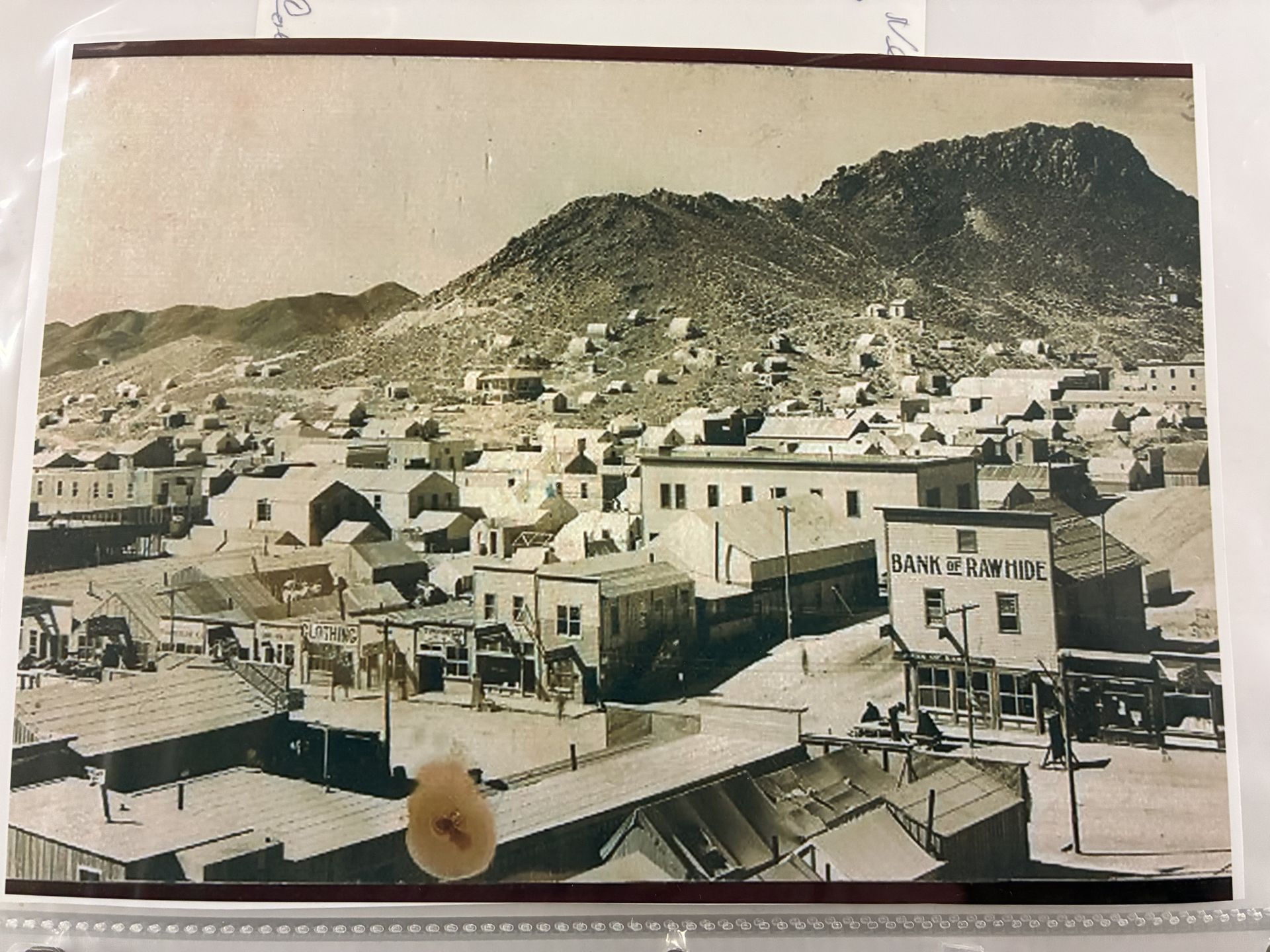
 The ghost town of Rawhide is just northeast of Pilot Cone in Mineral County, Nevada. The rise and fall of Rawhide only lasted about two years. It started in September of 1907 as a tent and grew to roughly 10,000 people in about 8 months. A true Boom and Bust town. In other parts of the country mining was slowing down and all eyes turned to Rawhide. It had one long main street, there was no planning of the town, first there were tents, then wooden structures. The population grew and so did the stories of new strikes. Work was plentiful. Speculators were mostly selling mining stock, not actually digging in the mines. There were no large mines, only several small mines. The production at Rawhide as shown by the Nevada Bureau of Mines 1908-1916, the years of the greatest production, was $1,287,246.00 in a combination of gold, silver, copper and lead.  Water was the biggest problem as it had to be hauled in, mostly from Dead Horse Wells, at five cents a gallon. A water system was started but it was abandoned before completion. A few businesses had water and others put in their own systems and hauled water to them. A railroad was planned, but never materialized.


The story of Rawhide would not be complete without talking about some of the people who lived there. Newspaper editors flocked to wherever there was talk of a new promising vein and Rawhide was no different. Swindlers also followed eager to capitalize on another’s hard work. There were also honest people who came hoping to make their fortunes in the booming area such as the Grutt brothers. Eugene, Fred, Emil and Leo Grutt helped make Rawhide famous. Eugene took the lead in running a mine on Grutt hill. Together they made money by buying and selling shares of stock. They also helped to organize the telegraph company. When Mineral County was formed from Esmerelda County, Eugene became Sheriff and served two terms from 1911-1919.


 Tex Rickard, a prize-fighting promoter, opened and operated a saloon called the Northern. Rickard had previously owned, with partners, a saloon in Goldfield also called the Northern and another in Nome, Alaska. He is credited with bringing prize fighting to Nevada.  Rickard never actively mined, his “gold” came from staking and selling claims, promoting prize fights, his Rawhide Northern saloon, and gambling.


Born Jacob Simon Herzig, George Graham Rice was a good-looking classy businessman and promoter (with nefarious intentions), who had a history of swindling people. He had spent two years in Elmira Reformatory for stealing from his father’s business. Jacob later spent four years in Sing Sing for forgery and stealing his father’s business. Upon his release from Sing Sing he took the name of another inmate, George Graham Rice. He had a Machiavellian personality. Rice wrote a book called “My Adventures With Your Money” while in the Nevada State Petitionary for mail fraud. He was an editor of a newspaper at one point and was considered partly responsible for Rawhide’s rise and fall.


Following an influenza epidemic and a flash flood which destroyed many buildings, the town kept going until a fire started at a rooming house and destroyed most of Rawhide. In January of 1909 there were only 2000 people left. There were a few residents, about a hundred people in the depression era who hung in there for many years up until about the mid-1960s. Anna Rechel was the last known resident, she lived with her brother until he died, and it was decided that it was not safe for her to be there by herself anymore. Visitors between the years of 1967 and the early 1980’s could still see standing buildings in Rawhide, including Mrs. Rechel’s house, an old Lumber Store that had been moved to Rawhide from Wonder, Nevada and several other buildings. 


A large mining operation became interested in the Rawhide area in the late 1980’s thanks to new mining technologies and an upswing in gold prices. The new mine operated for about 20 years before closing and leaving behind a huge open pit which had completely taken over the original town site. The mine ended operations in 2002-2003 and the pit itself has been permitted as a landfill. Visitors to the area will find nothing remaining of what was once, for a very brief period, a booming town called Rawhide.


Resources:

Historic Mining Camps of Rawhide Nevada by Hugh A Shamberger

A Miner of Her Own by Sally Zanjani

My Adventures with your Money by George Graham Rice

Wikipedia.org


Mineral County High School

By Kellie Zuniga January 14, 2026
This is a subtitle for your new post
By Kellie Zuniga December 2, 2025
This is a subtitle for your new post
By Kellie Zuniga November 4, 2025
The first attempt to use the gas chamber was not successful. It was used on Gee Jon. It was pumped into his cell while sleeping and there were too many leaks, which lead to construction of the gas chamber. After this failure, a makeshift airtight chamber was quickly constructed in the prison butcher shop out of a retrofitted barber chair. This gas chamber was tested on two kittens which died within 15 seconds. It was the worlds first use of the gas chamber. He was successfully executed, however there was a leak that allowed a liquid to drop on the floor which caused him to take as much as 10 minutes to die. The chair that was modified for the gas chamber is on display at the Mob Museum in Las Vegas. The story began on the evening of Aug. 27, 1921 when Tom Quong Kee, (age 74) a Chinese laundryman living in Mina, was awakened up by the sound of someone knocking on the back door of the little cabin where he lived. Kee, a member of the Bing Kong Tong Gang, made his way to the door clad in nothing but pajamas and a jacket, holding a candle as his only source of light. When he opened the door, he found two Chinese men at his door, one of the men shot and killed the elderly man. The senseless killing in the town of Mina was an act of Tong gang warfare that had been spreading from the Chinese-American communities of California and had now trickled down into neighboring Nevada. These feuds started when a member of the Hop Sing Tong stole a Chinese slave girl who had belonged to the Suey Sing Tong gang. To avenge the injustice – the Suey Sing council allied with the Bing Kong Tong gang and declared war on the Hop Sings. On the morning of Aug. 28, 1921, a Chinese vegetable peddler went looking for Kee. Peering through the windows of Kee’s cabin, the peddler saw the old laundryman on the floor. The peddler notified Mina Justice of Peace L.E. Cornelius, who turned the case over to Mineral County Sheriff Deputy W.J. Hammill. Deputy Hammill examined the body and the scene and traced two sets of footprints from Kee’s cabin to a spot where an automobile had been parked and some empty beer bottles had been left behind. Unbeknownst to the two men who had shot Kee, Deputy Hammill had observed the strangers at the Palace Café in Mina over a week earlier. They had been asking for work in the area. The deputy had been told that the two men were neither unemployed nor innocent, and instead were tong members sent to kill Kee. Deputy Hammill contacted Reno Police Chief John M. Kirkley to be on the lookout for a car bearing two Chinese male suspects. Taken into custody would be 29-year-old Gee Jon and 19-year-old Hughie Sing. Both were slight in stature and not physically intimidating. China-born Jon stood 5 foot, 5 ¼ inches and weighed 129 pounds. Sing, born in Carson City, measured only 5 foot, 2 ½ inches tall and tipped the scale at only 105 pounds. Kee had difficulty understanding and speaking English but Sing, could read, speak and write both English and Chinese, having attended grammar school in Carson City. Sing had only been a member of the Hop Sing Tong for two months prior to being enlisted to help Jon. After their arrest, both Jon and Sing were interrogated by the Reno police. Sing was advised that anything he said could be used against him in court. Hoping to be set free, he confessed to his role in the crime of killing Kee in Mina and implicated Jon. Both were taken back to Mina where they were held without bail until their preliminary hearing was held on Sept. 8, 1921. W.H. Chang, an attorney from San Francisco and most likely a Hop Sing Tong member would represent Jon and Sing in court. Sing withdrew his confession given to the Reno police and both waived the right to make a statement at the hearing. Their attorney entered pleas of “not guilty” for each man. The trial of Kee and Sing would be held in the Mineral County Courthouse in Hawthorne from Nov. 28 to Dec. 3, 1921 before the Seventh Judicial District Court. Both men denied being members of the Hop Sing Tong gang, shooting Kee or even going to Mina with intentions to kill the old laundryman. Their defense was they had “been to Tonopah where they had applied for work at a restaurant.” Sing explained that his confession to the Reno police was in belief that he would be freed immediately. After testimony of witnesses and law enforcement, the court wasn’t convinced. It was brought to the attention of the court that Sing had previously lived with Kee in Mina for two years. Sing’s knowledge of Kee, the town of Mina and his ability to speak English made him the best person to guide Jon to Kee. Both men were found guilty of the first-degree murder of Kee. District Judge J. Emmett Walsh handed down death sentences in 1922. A law had been passed in 1921 by the 30th session of the Nevada State Legislature and signed by Governor Emmett D. Boyle that all criminals sentenced to death were to be executed by means of lethal gas. Jon and Sing were the first to be affected by the passing of this new law. It was thought that gas was a more humane way to end the life of those convicted to death. Under the custody of Sheriff Frederick B. Balzar, Jon and Sing were taken to the Nevada State Prison in Carson City where they were incarcerated until their sentence was to be carried out. Sing had confidence in his attorney, but also was prepared for the worse stating, “I don’t think there is hope, unless maybe the Supreme Court does something. Our lawyer said he’d file something in the Supreme Court within thirty days, but if the court doesn’t act I guess we’ll have to die.” A stay of execution for the two men, who had been ordered to be executed between April 16-22, 1922, was granted. A long legal battle would begin. In January of 1923, the Nevada Supreme Court ruled that lethal gas execution was neither cruel nor unusual punishment. Mineral County District Attorney Jay H. White called the murder of Kee: “Purely a clean-cut premeditated murder without any extenuating circumstances. The crime was one of the most atrocious and cold-blooded in the history of the state. After reviewing all evidence, it was determined that Sing, 19, was only an accessory to the murder and his sentence was commuted to life in prison. Sing was put to work in the Nevada State Prison laundry and would later become a cook and “house boy” in the home of the warden. He was described as a model prisoner. Jon was left to face death alone and to be gassed to death for the murder of Kee in 1921 with the use of hydrocyanic gas (HCN). The morning of Gee’s execution would be cloudy, humid and cold, only 49°F. Jon had fasted for ten days prior and ate his last meal of ham, eggs, toast and coffee. At 9:35 a.m. two guards escorted him forty yards from his cell to the gas chamber. He was strapped into the execution chair where he began to weep. At 9:40 a.m. four pounds of HCN acid was introduced into the chamber. Despite Judge Walsh’s repeated objections, Sing was paroled in 1938 and moved to California. He died six months later; his death was described as “accidental”. The victim, Tom Quong Kee, an elderly laundryman, was buried in the Mina Cemetery shortly after his death in August of 1921.  References Wikipedia Mineral County Independent News Carson City Daily Appeal
More Posts