
TThe Daly Gang         

   Aurora, Nevada doesn’t look like much today. There are no buildings and you can barely find a pile of old boards. The graveyard is still in decent shape. However, Aurora has quite a past.  It was originally thought to be in California but after a government survey it was determined that it was in Nevada. That itself was big deal. Still there was another incident in 1864 that was much more infamous. It was the murder of William Johnson by John Daly and his gang.

    On February 2nd, 1864 John Daly and three of his gang members, William Buckley, James Masterson, John McDowell killed William Johnson over killing a horse thief named Jimmy Sears. Apparently, Sears stole a horse from Johnson’s Station, in what is now Wellington, Nevada. Johnson sent his hired hand to recover the horse, which he did and ended up killing Sears. The hired hand turned himself in and was let go with no charges. This made Daly angry since Sears was one of his partners in crime, and he swore to get revenge.

    Prior to February 2, John Daly already had a bad reputation from acts of violence that he had done in California. Daly and his gang were hired to protect the mine at $20.00 per day from claim jumpers. The Daly gang had members in prominent positions that were partners with him. He convinced people to hire one of his members (William Carder) as the town Marshal. For about two years there was reign of terror through the town. Evil elements entered politics. Good citizens were afraid to enter the town. 

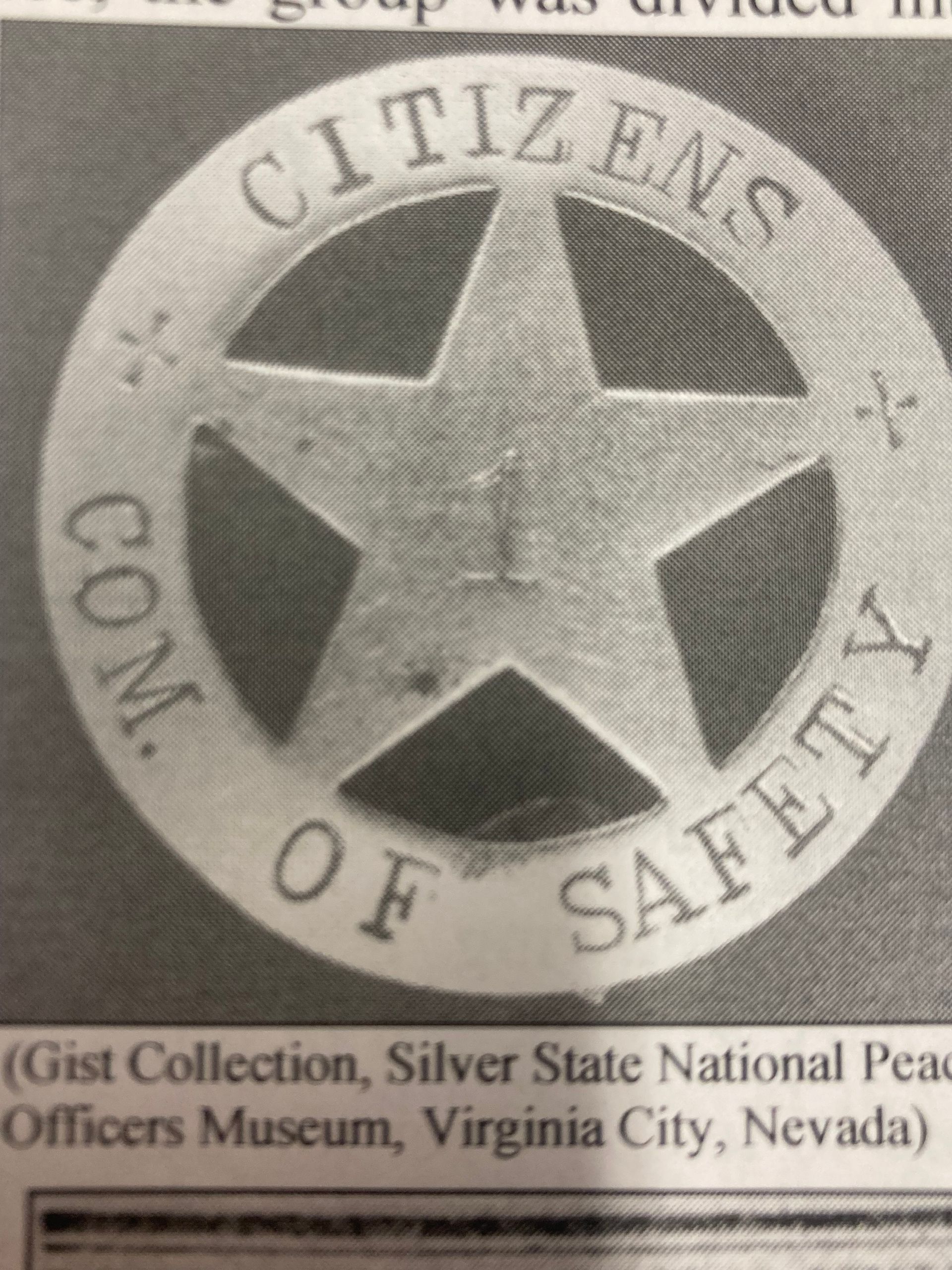
    This is when things get complicated, Aurora was recently changed from Mono County California to Esmerelda County Nevada. The marshal of Aurora was William Carder and the Sheriff of now Esmeralda County  was D. G. Francis. Daniel Pine replaced Carder and a Citizen Safety Committee formed right after the murder.  400 citizens volunteered to join the committee to assist the Sheriff with the situation. A coroner’s inquest was done by public officials. Once the interviews were done and found that they believed that John Daly and his gang were guilty, the Citizen Safety Committee took over until the hanging was done. 

    On February 9th John Daly, William Buckley, James Masterson and John McDowell were hung till their deaths. They are buried outside the Aurora Cemetery in unmarked graves. Nevada Territory Governor Nye, US Marshall Wasson and Provost Marshal Van Bokkelen arrived and stayed three nights. The Governor ordered the Safety Committee to return weapons to the armory and end all activities of the Committee. And all were threatened to be thrown in Fort Churchill if any more vigilante activity continued. Once the governor left, the Committee continued to round up roughs, to the towns dismay.

 For further reading I would suggest reading my Sources:

Book: The Last Days of the Daly Gang by Clifford Alpheus Shaw

Book: Mineral County Nevada Volume 1 and 4 by Sue Silver


Mineral County High School

By Kellie Zuniga December 2, 2025
This is a subtitle for your new post
By Kellie Zuniga November 4, 2025
The first attempt to use the gas chamber was not successful. It was used on Gee Jon. It was pumped into his cell while sleeping and there were too many leaks, which lead to construction of the gas chamber. After this failure, a makeshift airtight chamber was quickly constructed in the prison butcher shop out of a retrofitted barber chair. This gas chamber was tested on two kittens which died within 15 seconds. It was the worlds first use of the gas chamber. He was successfully executed, however there was a leak that allowed a liquid to drop on the floor which caused him to take as much as 10 minutes to die. The chair that was modified for the gas chamber is on display at the Mob Museum in Las Vegas. The story began on the evening of Aug. 27, 1921 when Tom Quong Kee, (age 74) a Chinese laundryman living in Mina, was awakened up by the sound of someone knocking on the back door of the little cabin where he lived. Kee, a member of the Bing Kong Tong Gang, made his way to the door clad in nothing but pajamas and a jacket, holding a candle as his only source of light. When he opened the door, he found two Chinese men at his door, one of the men shot and killed the elderly man. The senseless killing in the town of Mina was an act of Tong gang warfare that had been spreading from the Chinese-American communities of California and had now trickled down into neighboring Nevada. These feuds started when a member of the Hop Sing Tong stole a Chinese slave girl who had belonged to the Suey Sing Tong gang. To avenge the injustice – the Suey Sing council allied with the Bing Kong Tong gang and declared war on the Hop Sings. On the morning of Aug. 28, 1921, a Chinese vegetable peddler went looking for Kee. Peering through the windows of Kee’s cabin, the peddler saw the old laundryman on the floor. The peddler notified Mina Justice of Peace L.E. Cornelius, who turned the case over to Mineral County Sheriff Deputy W.J. Hammill. Deputy Hammill examined the body and the scene and traced two sets of footprints from Kee’s cabin to a spot where an automobile had been parked and some empty beer bottles had been left behind. Unbeknownst to the two men who had shot Kee, Deputy Hammill had observed the strangers at the Palace Café in Mina over a week earlier. They had been asking for work in the area. The deputy had been told that the two men were neither unemployed nor innocent, and instead were tong members sent to kill Kee. Deputy Hammill contacted Reno Police Chief John M. Kirkley to be on the lookout for a car bearing two Chinese male suspects. Taken into custody would be 29-year-old Gee Jon and 19-year-old Hughie Sing. Both were slight in stature and not physically intimidating. China-born Jon stood 5 foot, 5 ¼ inches and weighed 129 pounds. Sing, born in Carson City, measured only 5 foot, 2 ½ inches tall and tipped the scale at only 105 pounds. Kee had difficulty understanding and speaking English but Sing, could read, speak and write both English and Chinese, having attended grammar school in Carson City. Sing had only been a member of the Hop Sing Tong for two months prior to being enlisted to help Jon. After their arrest, both Jon and Sing were interrogated by the Reno police. Sing was advised that anything he said could be used against him in court. Hoping to be set free, he confessed to his role in the crime of killing Kee in Mina and implicated Jon. Both were taken back to Mina where they were held without bail until their preliminary hearing was held on Sept. 8, 1921. W.H. Chang, an attorney from San Francisco and most likely a Hop Sing Tong member would represent Jon and Sing in court. Sing withdrew his confession given to the Reno police and both waived the right to make a statement at the hearing. Their attorney entered pleas of “not guilty” for each man. The trial of Kee and Sing would be held in the Mineral County Courthouse in Hawthorne from Nov. 28 to Dec. 3, 1921 before the Seventh Judicial District Court. Both men denied being members of the Hop Sing Tong gang, shooting Kee or even going to Mina with intentions to kill the old laundryman. Their defense was they had “been to Tonopah where they had applied for work at a restaurant.” Sing explained that his confession to the Reno police was in belief that he would be freed immediately. After testimony of witnesses and law enforcement, the court wasn’t convinced. It was brought to the attention of the court that Sing had previously lived with Kee in Mina for two years. Sing’s knowledge of Kee, the town of Mina and his ability to speak English made him the best person to guide Jon to Kee. Both men were found guilty of the first-degree murder of Kee. District Judge J. Emmett Walsh handed down death sentences in 1922. A law had been passed in 1921 by the 30th session of the Nevada State Legislature and signed by Governor Emmett D. Boyle that all criminals sentenced to death were to be executed by means of lethal gas. Jon and Sing were the first to be affected by the passing of this new law. It was thought that gas was a more humane way to end the life of those convicted to death. Under the custody of Sheriff Frederick B. Balzar, Jon and Sing were taken to the Nevada State Prison in Carson City where they were incarcerated until their sentence was to be carried out. Sing had confidence in his attorney, but also was prepared for the worse stating, “I don’t think there is hope, unless maybe the Supreme Court does something. Our lawyer said he’d file something in the Supreme Court within thirty days, but if the court doesn’t act I guess we’ll have to die.” A stay of execution for the two men, who had been ordered to be executed between April 16-22, 1922, was granted. A long legal battle would begin. In January of 1923, the Nevada Supreme Court ruled that lethal gas execution was neither cruel nor unusual punishment. Mineral County District Attorney Jay H. White called the murder of Kee: “Purely a clean-cut premeditated murder without any extenuating circumstances. The crime was one of the most atrocious and cold-blooded in the history of the state. After reviewing all evidence, it was determined that Sing, 19, was only an accessory to the murder and his sentence was commuted to life in prison. Sing was put to work in the Nevada State Prison laundry and would later become a cook and “house boy” in the home of the warden. He was described as a model prisoner. Jon was left to face death alone and to be gassed to death for the murder of Kee in 1921 with the use of hydrocyanic gas (HCN). The morning of Gee’s execution would be cloudy, humid and cold, only 49°F. Jon had fasted for ten days prior and ate his last meal of ham, eggs, toast and coffee. At 9:35 a.m. two guards escorted him forty yards from his cell to the gas chamber. He was strapped into the execution chair where he began to weep. At 9:40 a.m. four pounds of HCN acid was introduced into the chamber. Despite Judge Walsh’s repeated objections, Sing was paroled in 1938 and moved to California. He died six months later; his death was described as “accidental”. The victim, Tom Quong Kee, an elderly laundryman, was buried in the Mina Cemetery shortly after his death in August of 1921.  References Wikipedia Mineral County Independent News Carson City Daily Appeal
By Kellie Zuniga October 6, 2025
This is a subtitle for your new post
More Posts